文献信息
Hildmann et al., arXiv:1307.6062 (2013),“Fidelity of optically induced single-spin rotations in semiconductor quantum dots in the presence of nuclear spins”. arXiv:1307.6062 原文为 arXiv 预印本版本的机器可读转换,公式与图注以原文为准;本页仅作站内索引与全文查阅,引用请以正式出版物为准。
全文
Fidelity of optically induced single-spin rotations in semiconductor quantum dots in the presence of nuclear spins
Julia Hildmann and Guido Burkard
Department of Physics, University of Konstanz, D-78457 Konstanz, Germany
We examine the influence of nuclear spins on the performance of optically induced rotations of single electron spins in semiconductor quantum dots. We consider Raman type optical transitions between electron spin states and take into account the additional efect of the Overhauser field. We calculate average fidelities of rotations around characteristic axes in the presence of nuclear spins analytically with perturbation theory up to second order in the Overhauser field. Moreover, we calculate the fidelity using numerical averaging over the nuclear field distribution, including arbitrary orders of the hyperfine interaction.
I. INTRODUCTION
Single electron spins in quantum dots represent a suitable physical system for the experimental realization of quantum bits (qubits) [1]. Since single- and two-qubit operations are suficient for implementing any arbitrary quantum gates [2], a large amount of research has been conducted for the realization of single qubit state control and two qubit operations [3–9]. Along with electrical control, one of the possibilities to manipulate single electron spin state is by optical means [4, 10–12], which ofer a fast and coherent way for control of spin state in quantum dots.
Experimental achievements in optical initialization, read-out, coherent control and manipulations of single electron spins in quantum dots [13–20] have reached a level at which their use for quantum information processing seems to be feasible. Additionally optical control ofers the possibility of incorporating electron spin qubits into hybrid systems in which the single spin state is entangled with the state of a photon and quantum information is transferred by photons [21–23].
The accomplishment of the essential steps for optimal optical single spin control is afected by diferent types of errors, e.g. imperfection of the applied laser pulses [11]. Mixing of heavy and light hole states influences the trion state, which is used in some schemes as an intermediate state [12, 20]. However, the mixing of the heavy and light holes in quantum dots can be controlled e. g. by means of anisotropic stress [24] and in this way the errors created by the phenomena can be avoided.
Another intrinsic mechanism causing decoherence of electron spins in III-V semiconductor quantum dots is their interaction with the nuclear spins of the host material [7, 25–27]. An electron confined in such a quantum dot interacts by hyperfine coupling with a large nuclear bath (roughly 105-106 nuclear spins per quantum dot). The total magnetic field of the nuclei, also called Overhauser field, fluctuates randomly and acts as an efective magnetic field on the electron, causing dephasing of the electron spin state. There are possibilities to improve the decoherence time by reducing the fluctuations of the Overhauser field. One such possibility is to polarize nuclear spins to a high degree [26], another is to drive or project the nuclear spin state into an eigenstate of the Overhauser field operator [28, 29]. A significant improvement of electron spin coherence time was observed in the experiments, where nuclear spin fluctuations were suppressed by driving the nuclear field to a stable state [30, 31].
In this paper, we focus on the single spin rotation errors arising from the interaction with an unpolarized ensemble of nuclear spins. One possibility to rotate the single spin states in a quantum dot is by using Raman transitions [4, 10] between single electron spin states split by magnetic field in Voigt geometry via the trion state comprised of two electrons and a heavy hole. In this case the transitions are driven by specifically detuned laser pulses (Fig. 1). The hyperfine interaction leads to a fluctuating spin state splitting and therefore to imperfect spin rotations.
To compare the single spin rotations in the presence and in the absence of nuclear spins we compute the fidelities of the unitary time evolution of the electron spin state under the action of the laser light with and without including the hyperfine interaction. We average the obtained fidelities over the Overhauser field distribution analytically to second order of the hyperfine coupling and numerically to an arbitrary order. We calculate the average fidelities for rotation axes parallel and perpendicular to the external magnetic field and discuss the factors that influence the average rotation fidelities in both cases.
The previous work on the performance of the two-qubit quantum operations in the presence of the hyperfine interaction showed that the fidelity depends on such conditions as the gradient of the nuclear fields between the two quantum dots [32]. The investigation of the fidelities of single-qubit rotations exposed the dependence on the relative orientation of the rotation axis relative to the external magnetic field. It was found that the dephasing time of the electron spin state difers if it is rotated around diferent axes. It would be interesting to confirm this observation for electron spin resonance on single spins in electrostatically defined or semiconductor nanowire quantum dots.
This paper is organized as follows. In Section II, we describe the mechanism of Raman type optical transitions between single electron states. We include the hyperfine interaction to the system in Section III and derive the time evolution operator of the single-spin state in the presence of the Overhauser field. The calculated rotation fidelities are presented in Section IV.
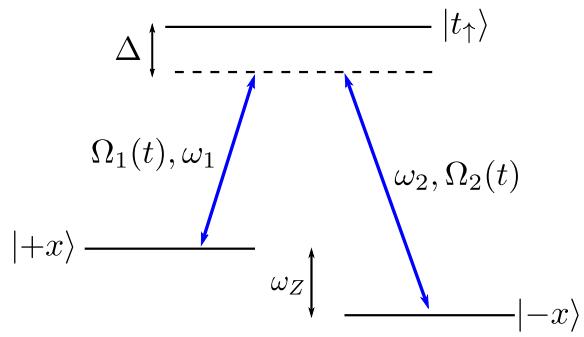
Figure 1. Energy level scheme for an electron spin interacting with polarized light. The transverse magnetic field splits x-eigenstates of the electron spin by the Zeeman energy The electron spin states are virtually coupled to the trion state by the laser pulses and with frequencies ω1 and ω2, with detuning
II. OPTICALLY INDUCED SINGLE SPIN ROTATIONS
The interaction between polarized light in the growth direction z and a single electron confined in a quantum dot is given by
where |↑i is the spin-up state in the conduction band and is the trion state formed by two electrons in the singlet state and a heavy hole with angular momentum is the energy of the trion state, and is the coupling to the laser field. With an additional magnetic field applied in x-direction, perpendicular to the growth direction (Voigt geometry), the Hamiltonian (1) reads in the basis 2
where is Zeeman splitting of the electron states Applying two-color laser pulses enables arbitrary rotation of the electron spin by a single pulse [10],
with Raman resonance conditions:
where is the laser detuning from the trion resonance (see Fig. 1) and α gives the relative phase between two lasers with real Rabi frequencies and . In the rotating frame given by 2 the Hamiltonian is
In the case , the fast oscillating terms can be neglected and the Hamiltonian becomes
This Hamiltonian describes the Λ system presented in Fig. 1. If the temporal profiles of the laser pulses for and are of rectangular shape and of the same width, the time dependance of the Rabi frequencies can be omitted. Assuming , we obtain the efective Hamiltonian by the Schriefer-Wolf transformation [4, 32],
The electron spin states are decoupled from the trion state and the efective single spin Hamiltonian reads,
where are the Pauli matrices in the basis of the states i. The time evolution operator for the Hamiltonian (4) can be represented as
where
is the vector of Pauli matrices and the components of the unit vector ˆn are given by
III. HYPERFINE COUPLING
To study the influence of nuclear spins on the performance of the spin rotations, we add the hyperfine interaction of an electron confined in a quantum dot to the
Hamiltonian (1), which is given by the contact Fermi interaction [27],
where S is the electron spin operator and h is the so called Overhauser field, the efective nuclear spin field, are the nuclear spin operators, is the hyperfine coupling strength of a nuclear spin at kth lattice site, and N is the number of nuclear spins interacting with the electron. According to the central limit theorem, the expectation value of the Overhauser field underlies a Gaussian distribution with average value at zero and with the standard deviation , where A is the average hyperfine constant. For our calculations we used and
The system Hamiltonian together with the hyperfine interaction is
where are the components of the Overhauser field, which is considered here to be a fluctuating efective magnetic field. If we express the Hamiltonian Eq.(6) in the same rotating frame as for Hamiltonian (3), it becomes
We can neglect again the fast oscillating terms under the assumption . In this way, the transverse terms from the hyperfine coupling are excluded from our calculations and the Hamiltonian in the rotating frame with included Overhauser field becomes
Choosing again the laser profiles of rectangular shape and the same width for and assuming that the Overhauser field is static, we can render the Hamiltonian time independent. The system undergoes the dynamics given by only during the laser pulse. Applying again the Schriefer-Wolf transformation and treating the nuclear field as a random field we obtain an efective Hamil tonian. Also here, the electron spin states are decoupled from the trion state and we can work only on the electron spin states subspace. For the single spin Hamiltonian we find (up to a constant)
The unitary time evolution operator of this Hamiltonian can be represented as
where
The components of the unit vector are
with
IV. FIDELITY
The deviation in the optical rotations of the electron spin state due to the coupling to nuclear spins is studied by calculating the fidelity of the time evolution. The fidelity for two unitary operators averaged over all possible initial states on which the operators are acting is given by [33, 34]
where n is the dimension of the Hilbert space, represents the ideal operator and is the actual operator. The fidelity of single spin rotation in the presence of nuclear spins is given by
The trace of the product of the perfect time evolution operator and the time evolution operator with Overhauser efect is given by
b)
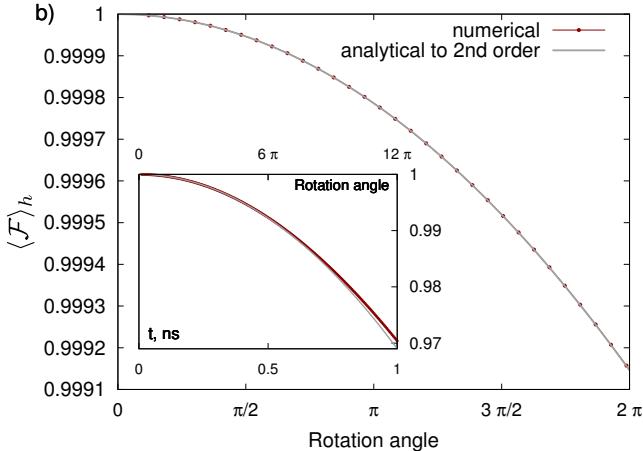
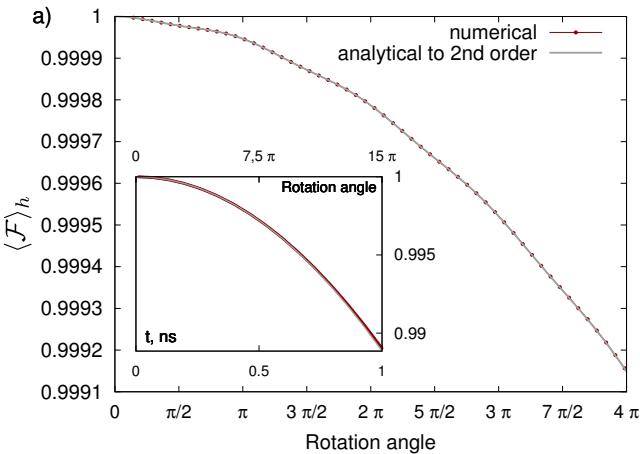
Figure 2. a) Fidelity for a generic spin rotation averaged numerically over Overhauser field distribution and its the average value to second order of the Overhauser field. Here meV, meV and meV. Inset: the average fidelity for a generic rotation on a longer time scale. The spin is rotated by around 15π after 1 ns. b) Fidelity for a spin rotation around the x axis averaged numerically over Overhauser field distribution and its the average value to second order of the Overhauser field. Here meV, and meV. Inset: the average fidelity for a rotation around x axis on a longer time scale (here 1 ns corresponds to a rotation angle of around 12π).
To obtain the average fidelity, we need to average the following expression analytically to a particular order or numerically over the Overhauser field distribution,
b)
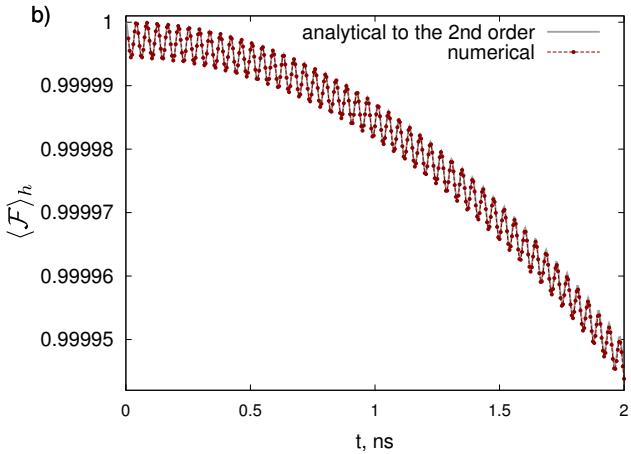
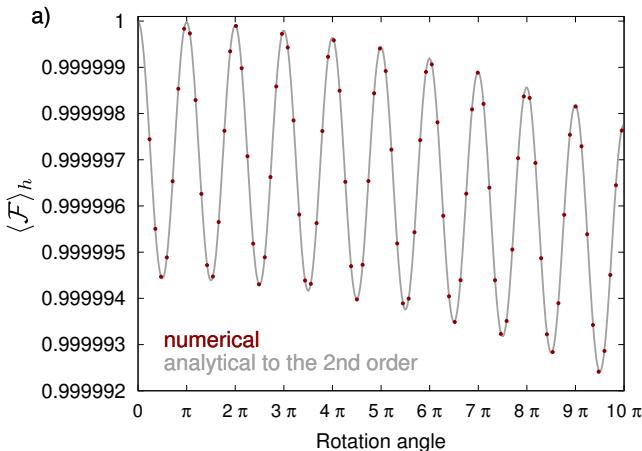
Figure 3. Fidelity for rotations around an axis nearly in the z plane averaged over nuclear spins numerically and to second order of hyperfine interaction: a) for short times and b) for longer duration of the laser pulses. Used parameters: meV, meV and meV.
The average fidelity to the second order of the Overhauser field is given by
where is the standard deviation of the Overhauser field distribution. The numerically obtained average fidelity is presented in comparison to the analytical result to second order of hyperfine interaction in Fig. 2 and 3.
Fig. shows the average fidelity for a rotation around a generic axis, which is not parallel or perpendicular to the characteristic axes. In this case and as it can be seen in Eq. (4) and (9). For the parameters meV, meV and meV the duration of rotation is 35 ps and the average fidelity is 0.999978. The average fidelities obtained both numerically and using second-order perturbation theory, Eq. (13), agree for short interaction times and remain in good agreement up to the nanosecond scale.
(b)
Fidelity as function of
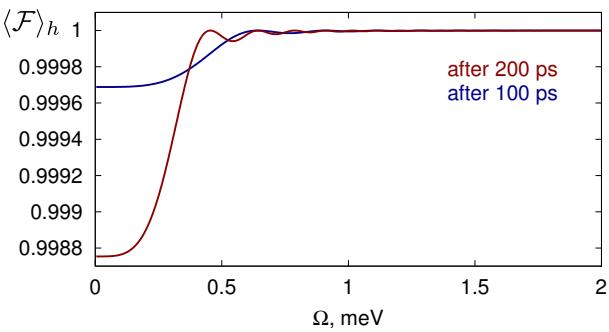
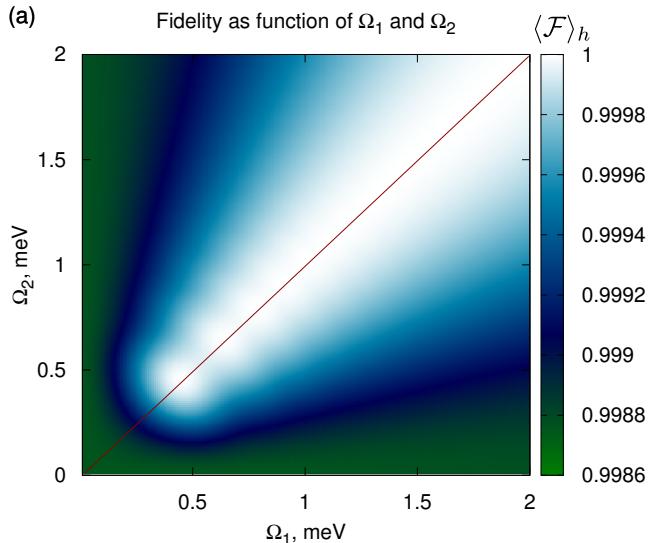
Figure 4. a) Average fidelity to second order of hyperfine interaction for meV as function of Rabi frequencies after meV. b) The special case of the average fidelity, when Rabi frequencies are equal: as function of Ω at meV for diferent interaction times: 100 ps (blue) and 200 ps (red).
The rotations around the axis along the magnetic field (x axis here) are obtained by setting or equal to zero. The average fidelity for such a rotation is shown in Fig. 2(b) with meV, and meV. For these parameters a rotation lasts around 41 ps and the average error for the rotation is The reduction of the average fidelity in this case is anticipated, since the rotation frequency is a quadratic function of both Rabi frequencies and the reduction of these frequencies leads to smaller and thus to smaller fidelities. The average fidelity obtained analytically to second order of the Overhauser field coincides with the numerically averaged fidelity for few full rotations around the x axis and reproduces it on the nanosecond scale (Fig. 2(b)).
The rotations around an axis lying in the plane (corresponding to the and terms in Eq. (4) and (9)) can be obtained by applying pulses with Furthermore, the rotation axis is specified by the phase α as shown in Eq. (4). However setting does not result in a rotation around an axis lying in the plane, if the electron spin interacts with the nuclear spins. The axis is rotated out of the plane because of the Overhauser field as can be seen in Eq. (9). The average fidelity of a single spin rotation around an axis, that is defined by meV and meV is shown in Fig. 3. The fidelity averaged over the nuclear spin distribution numerically to an arbitrary order and averaged analytically to the second order of the Overhauser field h is enhanced compared to the average fidelities in other cases presented in Fig. 2. The duration of a rotation reduces to 20 ps, while the average error for such rotation decreases to this strong improvement in fidelity cannot be explained only by increase of the interaction energy with the laser light ω. The increased average fidelity in the case, when is close to and vice versa can be attributed to the interplay of diferent contributions leading to a reduction of the average fidelity. As it can be seen in Eq. (13) the second term reduces the fidelity as and the third term as . When both Rabi frequencies and are of roughly the same value, the fidelity reducing term becomes less relevant compared to the term This can be observed in Fig. , where the average fidelity exhibits an oscillatory behavior for few full rotations around the given axis. The fidelity oscil lations become dominated by the ∝ decay for longer interaction times (Fig. 3(b)).
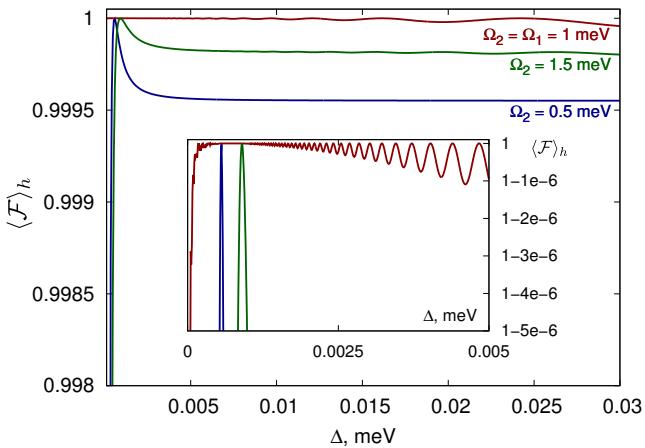
Figure 5. Average fidelity after 200 ps interaction time as function of the laser detuning for diferent Rabi frequencies: blue plot gives the average fidelity for meV, meV, green for meV, , and red plot is the special case of . Inset: the oscillations of the fidelity ∝ sin2 ωt to the unity in the case of equal Rabi frequencies.
The average fidelity depends not only on time (duration of the laser pulse), it also depends on the detuning and the Rabi frequencies, since they afect the interaction strength and rotation axis of the applied pulse. The density plots in Fig. 4 show the dependence of the average fidelity on the Rabi frequencies and the laser detuning. The calculations were done for a fixed time duration of 200 ps, which corresponds to a diferent rotation angle depending on the two Rabi frequencies. Fig. 4(a)
shows the dependence of the average fidelity on the two Rabi frequencies. The average fidelity increases as the Rabi frequencies grow, since it increases the interaction energy ω and shortens the time needed to perform certain rotations. What is remarkable here is the strong enhancement of the fidelity (up to unity) in the region, where . This means that the average fidelity of a single spin rotation depends on the rotation axis in addition to the rotation frequency. The rotations around axes perpendicular to the applied magnetic field are the least sensitive to the nuclear spin efects. The cut of the density plot in Fig. 4(a) for is shown in Fig. 4(b). As it can be seen in both Fig. 4(a) and 4(b) for small Ω the average fidelity has a constant value and then increases and oscillates. From the formula (13) we have for the average fidelity at the case and under assumption, that
For the fidelity oscillates with decreasing period and for (for t = 200 ps and meV this threshold is around is given by ≈ , which for is The last expression describes the average fidelity to second order of hyperfine interaction for an electron spin interacting just with a static magnetic field and nuclear spins. As it is shown in Fig. 4(b), this fidelity increases for shorter interaction times.
The behavior of the average fidelity for spin rotations at has a special character: it reaches unity when sin ωt = 0. This phenomenon is due to the overlap of two efects Without nuclear spins this situation corresponds to a rotation around an axis in the plane, but with the hyperfine interaction there is an additional fluctuation of the rotation axis perpendicular to the plane. In the case of these fluctuations average to zero. This leads to the result that only the of-diagonal elements of the time evolution operator are altered by the hyperfine interaction. But exactly this efect cannot be captured by the fidelity, when sin , because in this
[1] D. Loss and D. P. DiVincenzo, Phys. Rev. A 57, 120 (1998).
[2] D. P. DiVincenzo, Phys. Rev. A 51, 1015 (1995).
[3] G. Burkard, D. Loss and D. P. DiVincenzo, Phys. Rev. B 59, 2070 (1999).
[4] A. Imamo˘glu, D. D. Awschalom, G. Burkard, D. P. Di-Vincenzo, D. Loss, M. Sherwin and A. Small, Phys. Rev. Lett. 83(20), 4204 (1999).
[5] J. R. Petta, A. C. Johnson, J. M. Taylor, E. A. Laird, A. Yacoby, M. D. Lukin, C. M. Marcus, M. P. Hanson, and A. C. Gossard, Science 309, 2180 (2005).
[6] F. H. L. Koppens, C. Buizert, K. J. Tielrooij, I. T. Vink, K. C. Nowack, T. Meunier, L. P. Kouwenhoven, and L. M. K. Vandersypen, Nature 442, 766 (2006).
case the ideal time evolution operator is the identity operator. Consequently, the trace of the product of the time evolution operators, the ideal one and one with hyperfine interaction, does not contain the of-diagonal terms of the afected time evolution operator, which results in a perfect fidelity. This can also be seen in the dependence of the fidelity on the laser detuning in Fig. 5. For differing Rabi frequencies the average fidelity reaches unity only once at , which corresponds to the situation when the optical Stark shift compensates the effective magnetic field induced by nuclei, and then decays to a value given by For equal Rabi frequencies the fidelity oscillates with increasing period and reaches unity again for sin ωt = 0.
V. CONCLUSIONS
We studied the nuclear spin efect on the performance of Raman assisted optical transitions of an electron spin in a semiconductor quantum dot. It was shown that the average rotation fidelities obtained using secondorder perturbation theory are in good agreement up to nanoseconds time scale with the numerically averaged fidelities. The average fidelities were calculated for diferent rotation axes using both approaches. In the framework of the formalism used for describing the interaction of the single electron spin with the laser light the average rotation fidelities difer strongly for diferent rotation axes. While the rotations around axes in the plane, perpendicular to the applied magnetic field sufer at least under interaction with nuclear spins, the rotations around the x-axis, which is parallel to the external magnetic field, are the most efected by the hyperfine interaction.
VI. ACKNOWLEDGMENTS
We gratefully acknowledge funding from the DFG within SFB 767 and from BMBF under the program QuaHL-Rep.
[7] V. Cerletti, W. A. Coish, O. Gywat, and D. Loss, Nanotechnology 16, R27 (2005).
[8] R. Hanson, J. R. Petta, S. Tarucha, and L. M. K. Vandersypen, Rev. Mod. Phys. 79, 1217 (2007).
[9] Ch. Kloefel and D. Loss, Ann. Rev. Cond. Matt. Phys. 4, 51 (2013).
[10] P. Chen, C. Piermarocchi, L. J. Sham, d. Gammon, and D. G. Steel, Phys. Rev. B 69, 075320 (2004).
[11] S. E. Economou, L.J. Sham, Y. Wu and D. G. Steel, Phys. Rev. B 74, 205415 (2006).
[12] S. E. Economou and T. L. Reinecke, Phys Rev. Lett. 99, 217401 (2007).
[13] M. Atat¨ure, J. Dreiser, A. Badolato, A. H¨ogele, K. Karrai, and A. Imamo˘glu, Science 312, 551 (2006).
[14] M. H. Mikkelsen, J. Berezovsky, N. G. Stoltz, L. A. Coldren and D. D. Awschalom, Nat. Phys. 3, 770 (2007).
[15] J. Berezovsky, M. H. Mikkelsen, N. G. Stoltz, L. A. Coldren and D. D. Awschalom, Science 320, 349 (2008).
[16] D. Press, T. D. Ladd, B. Zhang and Y. Yamamoto, Nature 456, 218 (2008).
[17] F. Dubin, M. Combescot, G. K. Brennen and R. Melet, Phys. Rev. Lett. 101, 217403 (2008).
[18] X. Xu, B. Sun, P. R. Berman, D. G. Steel, A. S. Bracker, D. Gammon, and L. J. Sham, Nat. Phys. 4, 692 (2008).
[19] A. Ramsay, S. Boyle, R. Kolodka, J. Oliveira, J. Skiba-Szymanska, H. Liu, M. Hopkinson, A. Fox, and M. Skolnick, Phys. Rev. Lett. 100, 197401 (2008).
[20] V. Loo, L. Lanco, O. Krebs, P. Senellart, and P. Voisin, Phys. Rev. B 83, 033301 (2011).
[21] R.-B. Liu, W. Yao, L. J. Sham, Advances in Physics 59:5, 703 (2010).
[22] W. B. Gao, P. Fallahi, E. Togan, J. Miguel-Sanchez, and A. Imamo˘glu, Nature 491 426 (2012).
[23] J. R. Schaibley, A. P. Burgers, G. A. McCracken, L.- M. Duan, P. R. Berman, D. G. Steel, A. S. Bracker, D. Gammon, Phys. Rev. Lett. 110(16), 167401 (2013).
[24] J. D. Plumhof, R. Trotta, V. Kˇr´apek, E. Zallo, P. Atkinson, S. Kumar, A. Rastelli and O. G. Schmidt, Phys. Rev. B 87, 075311 (2013).
[25] A. V. Khaetskii, D. Loss, and L. Glazman, Phys. Rev. Lett. 88, 186802 (2002).
[26] W. A. Coish and D. Loss, Phys. Rev. B 70, 195340 (2004).
[27] W. A. Coish and J. Baugh, Phys. Stat. Solidi (b) 246, 2203 (2009).
[28] D. Stepanenko, G. Burkard, G. Giedke, and A. Imamo˘glu, Phys. Rev. Lett. 96, 136401 (2006).
[29] M. Issler, E. Kessler, G. Giedke, S. Yelin, I. Cirac, M. Lukin and A. Imamo˘glu, Phys. Rev. Lett. 105, 267202 (2010).
[30] X. Xu, W. Yao, B. Sun, D. G. Steel, A. S. Bracker, D. Gammon, and L. J. Sham, Nature 459, 1105 (2009).
[31] H. Bluhm, S. Foletti, D. Mahalu, V. Umansky, and A. Yacoby, Phys. Rev. Lett. 105, 216803 (2010).
[32] J. Hildmann and G. Burkard, Phys. Rev. B 84, 205127 (2011).
[33] L. Pedersen, N. Moller, and K. Molmer, Phys. Lett. A 367, 47 (2007).
[34] J. Ghosh and M. R. Geller, Phys. Rev. A 81, 052340 (2010).